Picture this: you’re standing in the supplement aisle, scanning shelves stacked with 30 products all promising to “calm stress naturally.” There’s ashwagandha, L-theanine, kava, passionflower, magnesium, GABA, and half a dozen blends with names like “Serenity Now.” No dose information makes sense, the ingredient lists run a mile long, and the price tags range from eight dollars to eighty. Most people grab something that sounds familiar or has the prettiest label and hope for the best. If you’re trying to figure out which supplements for anxiety actually work, you’re not alone, and the answer requires more than a label scan.
Questions about using supplements to manage anxiety come up constantly in integrative psychiatric practice, and for good reason. Many people managing anxiety feel like their options narrow down to prescription medication or white-knuckling through daily life, a generalization that holds up in clinical experience even if it doesn’t capture every person’s story. The goal of integrative care is to treat the whole person: nervous system, gut, nutrition, sleep, and yes, medications when warranted. Evidence-based anxiety supplements are a legitimate part of that picture, but only when chosen thoughtfully.
Here’s the thing: “natural” does not automatically mean safe, effective, or even close to the dose that actually worked in a clinical trial. What follows is a breakdown of what the research actually supports, what you need to know about dosing and form, and where the real safety risks live.
Why Supplements Become Part of the Anxiety Conversation
For some people, medication is genuinely helpful and the right fit. For others, it addresses part of the picture but not all of it, anxiety stays manageable on good days but resurfaces under stress, poor sleep, or hormonal shifts. This gap is exactly where integrative care earns its place, by looking at nutrition, nervous system support, and anti-anxiety supplements as tools that work alongside solid clinical care rather than replacing it.
The supplement industry operates under very different rules than pharmaceutical manufacturing. Marketing claims are not required to be proven before a product hits shelves. That means it falls on the consumer, and ideally a knowledgeable clinician, to ask the harder questions: Has this been tested in randomized controlled trials? Have those results been replicated? Is the dose in the bottle anywhere close to the dose that actually showed results? The supplements covered here have at least some quality trial data supporting them, though the strength of that evidence varies considerably.
Supplements for Anxiety: Ashwagandha and L-Theanine
Ashwagandha consistently earns strong clinical backing among herbal supplements for anxiety. A 2021 systematic review and meta-analysis published in BJPsych Open found significant reductions in anxiety scores and measurable drops in serum cortisol after eight weeks of use, though the authors rated the overall certainty of evidence as low, meaning benefits are supported but not yet proven at high confidence. The dose that drove those results was 500 to 600 mg per day of a standardized root extract, typically labeled as containing 5% withanolides or identified by the branded extract KSM-66. Lower doses are less likely to produce the same effect, and the dose-response data suggest that pushing above 1,000 mg per day increases side effects without adding benefit. Ashwagandha is not a supplement you’ll feel working after two days: those same clinical trials show effects building over six to eight weeks of consistent use. For details on individual clinical trials supporting these findings, see this published trial.
Ashwagandha Safety: What to Know Before You Start
One important safety note: a documented case report describes serotonin syndrome occurring when high-dose ashwagandha was combined with escitalopram. If you’re already taking an SSRI or SNRI, this isn’t a solo experiment, bring it to your prescriber before starting.
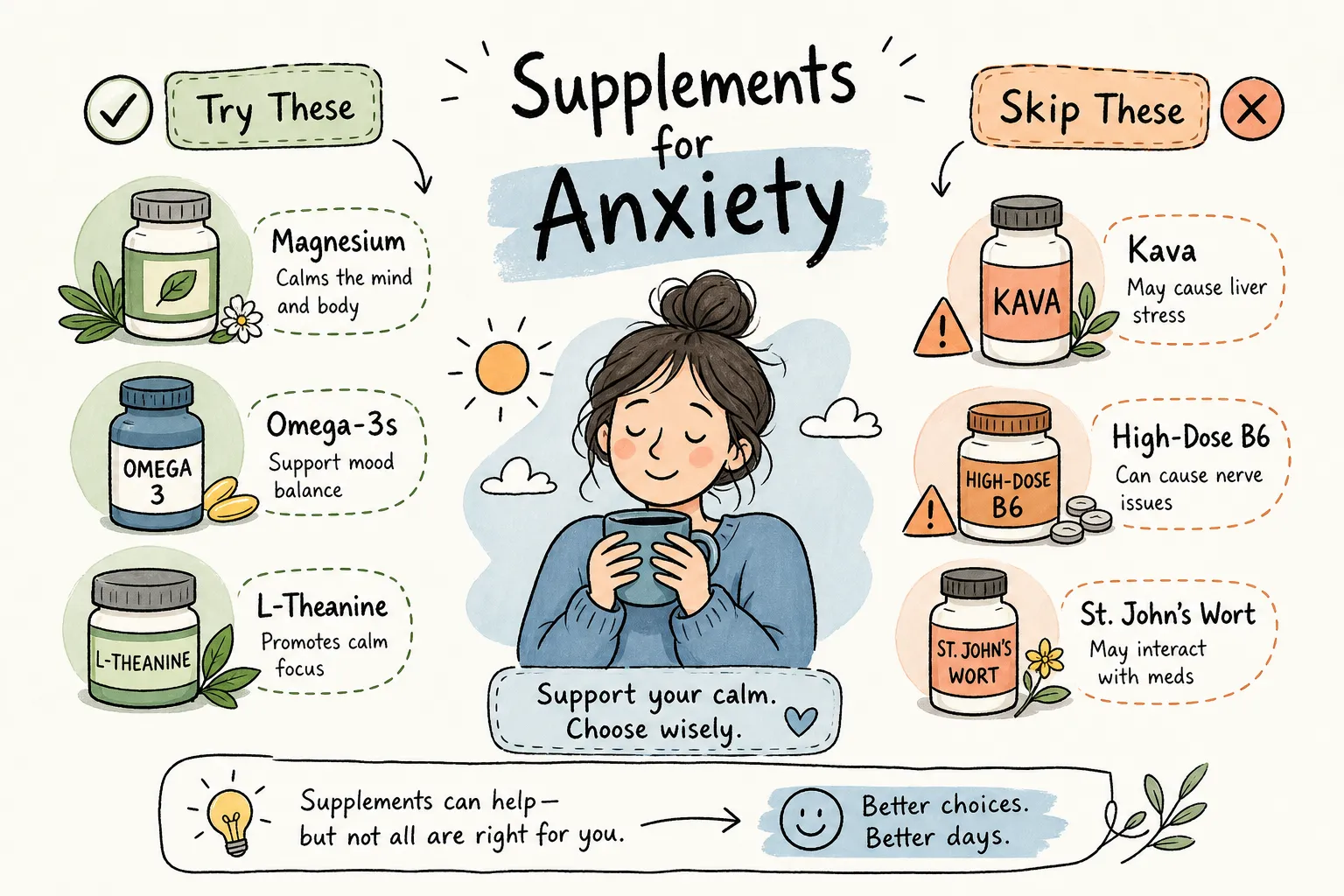
L-theanine is an amino acid found naturally in green tea that promotes alpha brain wave activity, the state associated with calm alertness without sedation, as demonstrated in EEG studies measuring neural oscillations after administration. Clinical trials support 100 to 200 mg for reducing acute stress responses and improving sleep quality without next-morning grogginess. It also pairs well with caffeine for people who find that their morning coffee amplifies anxiety, research on the combination shows it tends to smooth out the spike that caffeine alone can cause, making it a practical, low-risk option for daily use.
Foundational Nutrients and Supplements for Anxiety: Magnesium, Omega-3s, and B Vitamins
Magnesium is implicated in stress-response physiology through its involvement in HPA axis regulation, the body’s central system for managing stress. A significant portion of adults don’t get enough from diet alone, yet this deficiency rarely gets tested in a standard workup. A 2017 review in Nutrients found that magnesium supplementation reduced anxiety scores, particularly in individuals with documented deficiency, though the authors noted that overall evidence quality across studies was variable. The form you choose matters considerably. Magnesium glycinate is highly bioavailable and delivers glycine, an inhibitory neurotransmitter with its own calming effects, making it better absorbed and more likely to support relaxation than cheaper alternatives. Magnesium oxide, the most common form on store shelves, has poor bioavailability and functions primarily as a laxative. A typical therapeutic dose is 200 to 400 mg of glycinate or citrate daily, ideally taken at night. For a practical clinician-oriented discussion on magnesium and anxiety, see this overview from the Cleveland Clinic: magnesium for anxiety.
A 2018 meta-analysis of 19 clinical trials found that omega-3 fatty acids from fish oil can meaningfully reduce anxiety, but only at doses of 2,000 mg or more of combined EPA and DHA per day. Below that threshold, the trials showed no significant benefit. The ratio of EPA to DHA matters as well: subgroup analyses point to formulations where EPA makes up less than 60% of the total omega-3 content, roughly a 1:1 ratio, as producing the best anxiety outcomes. Most standard fish oil capsules contain 300 to 500 mg of combined EPA/DHA per serving, which means reaching a therapeutic amount requires reading the supplement facts panel carefully and doing the math.
B vitamins, particularly B6 and B12, support neurotransmitter synthesis, and deficiencies in either have been linked to worsened anxiety and depressive symptoms in observational and clinical research. A quality B-complex covers both without requiring separate pills. One important caveat with B6: while 100 mg per day showed anxiety-reducing effects in clinical research, consistently exceeding that amount risks peripheral nerve damage over time. More is not better here.
Why Dosing and Form Matter More Than the Front Label
One of the most consistent gaps between supplement research and what ends up on store shelves is the dose. Ashwagandha at 100 mg looks identical to ashwagandha at 600 mg in terms of packaging, but only one of them matches the clinical evidence. The same principle applies across the board. Most products are formulated to keep costs low rather than to hit therapeutic thresholds, a reality worth keeping in mind when comparing retail options to what trials actually tested.
Timing also affects how well these supplements work. Magnesium, L-theanine, and lavender oil, another well-studied option with a specific oral form called Silexan, where randomized trial data support 80 mg taken at night, are most effective in the evening, where they support both anxiety relief and sleep quality. Ashwagandha is best taken with food to reduce the risk of stomach upset. Standardization language on the label (such as “5% withanolides” or a named extract like KSM-66) confirms you’re getting a consistent, research-matched compound rather than a generic powder of unknown potency.
Safety Risks and Who Needs to Proceed Carefully
Kava has clinical trial evidence for anxiety reduction, but it also carries an FDA consumer advisory for hepatotoxicity, meaning liver damage, including documented cases requiring liver transplantation. The FDA first issued this advisory in 2002 and reinforced it in a 2020 scientific memorandum, expressing serious concern about indiscriminate kava use and its risks to liver health. Risk appears highest with organic solvent extracts (ethanol or acetone-based), doses above 250 mg, concurrent alcohol use, and pre-existing liver conditions, based on FDA and WHO reviews of reported cases (review of reported cases). Kava also powerfully amplifies sedation when combined with benzodiazepines, opioids, sleep aids, or muscle relaxants. For most people already managing anxiety with psychiatric medications, kava is a supplement to avoid entirely.
St. John’s wort carries its own significant interaction risk. It induces CYP450 liver enzymes, which can reduce the blood levels and effectiveness of antidepressants, oral contraceptives, blood thinners like warfarin, and immunosuppressants. Combined with SSRIs or SNRIs, it also raises the risk of serotonin syndrome. Despite being marketed primarily for mood support, it belongs in the “ask your provider first” category for anyone on prescription medications.
Certain populations need extra caution across the board. Pregnant and breastfeeding people should treat supplements with the same caution as prescription drugs: many haven’t been studied in these groups, and some, kava included, are explicitly contraindicated. Older adults face higher interaction risk because metabolism slows with age and polypharmacy is more common, creating more opportunities for one compound to affect another. Anyone already taking antidepressants, benzodiazepines, or other psychiatric medications should discuss any new supplement with their prescriber before starting. The more medications already in the picture, the more important that conversation becomes.
Accessing Quality Supplements Without the Guesswork
The FDA does not require pre-market approval for dietary supplements, which means quality, potency, and purity can vary dramatically between brands. Third-party testing certifications from organizations like NSF International, USP, or Informed Sport indicate that an independent lab has verified the product contains what the label claims and isn’t contaminated with heavy metals or unlisted substances. Many products on grocery store shelves lack these certifications, and a higher price tag is not a reliable substitute for independent verification.
At Magnolia Mental Health and Wellness, patients have access to a virtual Fullscript dispensary where supplement recommendations are practitioner-curated rather than algorithm-generated. Supplement protocols through this platform are built around each person’s clinical picture, including their current medications, lab values, and treatment goals, using professional-grade brands selected for their manufacturing quality. For people in Mississippi, whether seen in person in Gulfport or through telehealth anywhere in the state, this removes the frustration of navigating the supplement aisle alone and ensures that anything added to a wellness plan fits safely alongside existing care.
Putting It All Together: Choosing Supplements for Anxiety Wisely
Supplements are not a replacement for proper psychiatric care, but the right ones, at the right doses, with attention to quality and interactions, can meaningfully support nervous system regulation. Ashwagandha and L-theanine have solid trial support for calming an overactive stress response. Magnesium glycinate, omega-3s at therapeutic doses, and a quality B-complex address foundational nutritional gaps that often go undetected in people with chronic anxiety. The risks around kava and herb-drug interactions are real and should not be dismissed as unlikely edge cases.
Most importantly, if you’re already managing anxiety with prescription medication, adding supplements is a clinical conversation, not a solo experiment. Individual factors like your current medications, health history, and specific symptoms all shape which options are appropriate and at what doses. A thoughtful provider looks at the whole picture before making recommendations, not just what’s trending on a wellness blog.
If you’d like personalized guidance on which supplements for anxiety may suit your situation, Magnolia Mental Health and Wellness is here to help you build a protocol that actually fits your life and supports your long-term mental health. Reach out to schedule an evaluation, in person in Gulfport or via telehealth across Mississippi.